Concept vs Construction
Designers, educators, and commentators often use the terms’ fashion’ and ‘apparel’ interchangeably. In practice, they describe two distinct stages of the same journey. Fashion expresses a concept. Apparel turns that concept into a manufactured, wearable product.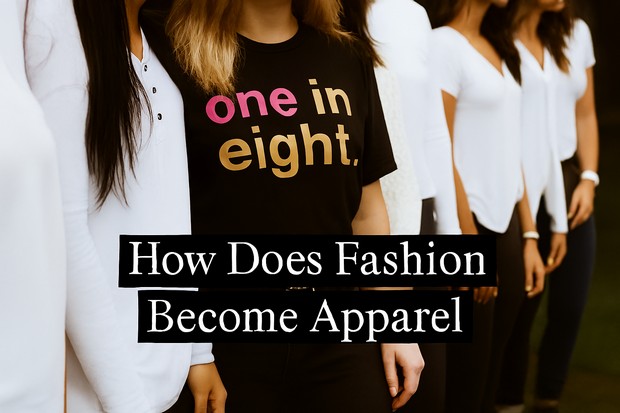
The difference matters because it determines whether a concept remains symbolic or becomes viable. In its early form, fashion exists in a creative environment largely insulated from constraint. Mood, proportion, narrative, and aesthetic direction shape it. Apparel operates under a different logic. It must fit bodies, respond to fabric behaviour, withstand wear, and move through production systems without losing integrity.
The transition from fashion to apparel is not automatic. It requires translation. That translation introduces material, technical, and commercial considerations that reshape the original idea. Structure tests concepts that thrive under visual freedom. Some adapt and strengthen. Others expose weaknesses that remained invisible at the conceptual stage.
Understanding this shift is essential for designers, students, and brand builders. The move from concept to clothing is not a dilution of creativity. It is the point at which creativity proves its durability.
Fashion as Concept
Fashion begins in abstraction. It develops through sketches, digital layouts, fabric swatches, colour studies, and visual systems that define identity. At this stage, imagination leads. The objective is clarity of expression rather than proof of feasibility.
Conceptual work establishes direction. It defines aesthetic boundaries. It determines whether a brand feels restrained or expressive, minimal or layered, structured or fluid. Typography, silhouette, and colour operate as tools of communication. They articulate intent long before a garment reaches production.
Within this environment, scale can be exaggerated. Layouts can prioritise impact over efficiency. Colour combinations can explore contrast without immediate concern for production limitations. The work remains speculative.
This freedom is not a flaw. It is necessary. Without a defined concept, apparel risks becoming reactive rather than intentional. Brands that bypass conceptual development often default to generic forms, imitating prevailing trends rather than shaping their own position.
However, conceptual fashion operates in isolation from consequence. It has not yet encountered the friction of material behaviour or the cost structure. It does not yet account for grading across sizes, seam placement, or ink absorption. A design can exist convincingly in a digital file while remaining untested in physical form.
The conceptual phase, therefore, represents potential rather than completion. It frames ambition. It does not guarantee execution.
Designers who recognise this treat concept development as groundwork. They build visual systems that allow adaptation without collapse. They understand that reduction, refinement, and constraint will follow. When that awareness is absent, friction appears later, during translation.
Fashion, as a concept, defines what a brand wants to say. Apparel determines whether that statement can hold form.
Apparel as Technical Translation
Apparel introduces structure. It requires that fashion pass through measurable systems: pattern drafting, grading, fabric selection, construction logic, and production sequencing. Each of these disciplines imposes boundaries that shape how a concept can survive.
Once a design moves toward garment form, it becomes subject to spatial realities. Fabric drapes differently depending on weight and fibre composition. Stretch alters proportion. Seams interrupt visual continuity. The body itself introduces curvature and movement that do not exist on a flat layout.
Technical translation demands precision. Patterns must account for mobility and balance. Measurements must be consistent across size ranges. Construction tolerances narrow as production volume increases. What appears symmetrical on screen must align physically on a three-dimensional form.
Material behaviour plays a central role in this transition. A tightly woven cotton will support graphics differently from a lightweight blended knit. A brushed fleece will absorb ink differently from a smooth jersey. Base fabric tone influences how colour reads. Surface texture affects clarity.
These variables do not restrict creativity; they redefine it. Designers who work effectively in apparel anticipate them. They adjust contrast to maintain legibility. They consider how graphics sit relative to seam lines. They refine placement to ensure consistency across sizes.
Scale requires particular attention. A composition balanced for a single sample size may appear distorted when graded. The relationship between the graphic and the garment shifts as the dimensions change. Without deliberate recalibration, the proportions become uneven.
Apparel also introduces repeatability. A concept must not only function once but function consistently across multiple units and production runs. Production teams document placement measurements. Designers prepare artwork at the final dimensions. Files must meet print resolution requirements. These details ensure that a design reproduces faithfully rather than approximately.
The shift from fashion to apparel is therefore procedural as much as aesthetic. It demands documentation and discipline. It replaces intuitive adjustment with specification.
At this stage, the concept is no longer protected by presentation. It must withstand manufacturing.
Where Concepts Commonly Break Down
The transition from fashion to apparel often reveals structural weaknesses. These weaknesses rarely stem from a lack of creativity. They stem from a lack of translation.
Overcomplexity is one of the most common points of failure. Layered graphics, dense typography, and expansive colour palettes can feel resolved within a conceptual environment. On fabric, they compete for attention. Ink behaves differently from pixels. Movement alters perception. Detail compresses.
Typography illustrates this clearly. Fine adjustments in kerning and hierarchy that appear controlled digitally may lose clarity once printed on textured surfaces. Letterforms can soften. Spacing can feel uneven. Subtle distinctions may disappear at a distance.
Colour also shifts in physical form. Fabric absorbs light rather than emitting it. Saturation levels depend on fibre content and the dye base. Tonal gradients may flatten. High-contrast schemes can overwhelm when applied at scale. Without deliberate editing, visual coherence weakens.
Scale and placement compound these issues. A graphic proportionate to a sample may appear overwhelming at a smaller size or diminished at a larger one. A visually centred placement may conflict with seam construction or garment cut. Without systematic testing, inconsistency emerges.
Another breakdown occurs when designers treat garments as flat canvases. Apparel wraps around bodies. It folds, stretches, and moves. A layout that depends on static alignment may distort in motion. The difference between presentation and wear becomes visible.
These failures are rarely dramatic. They appear as small compromises that accumulate. A print that feels slightly heavy. A colour that reads slightly muted. A layout that feels slightly misaligned. Individually minor, collectively significant.
Strong apparel design avoids these breakdowns through restraint and editing. It reduces complexity to protect clarity. It anticipates distortion and compensates for it. It treats material behaviour as a design parameter rather than an obstacle.
The discipline required at this stage often feels corrective. In practice, it strengthens the concept. Removing excess clarifies intent. Adjusting the scale restores proportion. Simplifying colour sharpens contrast.
The transition from fashion to apparel is therefore not about diminishing ambition. It is about refining it. Concepts that withstand this refinement prove their structural integrity.
Those that cannot were never fully resolved.
Print and Customisation as the Bridge
The point at which fashion becomes apparel is most visible when design meets application. Nowhere is this clearer than in printed and customised garments. Here, the production process physically fixes visual identity to fabric. The concept must hold form.
Custom garment production provides a practical lens through which to understand this translation. It exposes how graphic systems behave when applied to textiles. It forces clarity around placement, scale, and material interaction. It reveals whether an idea is robust or merely attractive in isolation.
Custom garment production offers one of the clearest examples of fashion becoming apparel. In this environment, designers physically apply graphic ideas, slogans, identity systems, and visual concepts to textiles and test them in the real world. Effective custom clothing services act as a bridge between creative intent and production reality. They require designers to think not only about what looks good conceptually, but what will hold form across fabrics, sizes, and print methods. Decisions around placement, scale, ink density, and garment choice directly influence how faithfully a design survives the transition.
This bridge exposes weaknesses quickly. A composition that relied on subtle tonal variation may lose distinction once printed. Typography that appeared refined on screen may soften on textured surfaces. Dense layouts can feel visually heavy when worn in motion.
Print and customisation demand discipline. The process rewards clarity of hierarchy, favours intentional negative space, and requires awareness of how colour interacts with the base fabric. Designers must define placement precisely rather than approximate it visually.
This stage often drives refinement. Designers edit concepts. They remove excess. They adjust the scale. The translation process becomes deliberate rather than reactive.
The value of this phase lies not in decoration alone, but in validation. When a concept withstands physical application without distortion, it demonstrates structural strength. When it fails, the correction is instructive. It reveals where fashion was aspirational rather than executable.
Customisation, therefore, is not a secondary consideration. It is a proving ground. It clarifies whether a design system is adaptable across garments, fabrics, and contexts. It tests repeatability and consistency. It exposes the relationship between identity and manufacture.
In this sense, the move from concept to apparel is neither automatic nor decorative. The production process negotiates it through craft.
Scaling, Production, and Commercial Reality
The transition does not end with a successful sample. Apparel must function at scale. A garment that works once must work repeatedly, across sizes, batches, and production runs.
Scaling introduces new pressures. Patterns must hold across graded dimensions. Placement must remain proportionate from the smallest to the largest size. Production teams must maintain colour consistency across multiple dye lots. Print alignment must remain replicable.
These demands shift the designer’s role from creative author to system thinker. The garment becomes part of a production workflow. Documentation replaces approximation. Specifications replace intuition.
Commercial viability also becomes visible at this stage. Fabric choice affects cost structure. Print method influences unit economics. Complexity impacts production time. A design that requires excessive manual adjustment may become impractical beyond limited runs.
Production discipline does not diminish creativity. It strengthens strategic awareness. Strong apparel design balances efficiency with identity. It aligns ambition with manufacturability.
Costing, in particular, reframes decision-making. A garment that appears refined conceptually may require production steps that inflate margins unsustainably. Excessive colour separations, intricate placements, or specialised fabrics introduce friction.
Effective designers recognise that constraint sharpens focus. They identify which elements define identity and which they can reduce without loss of meaning. They build systems rather than singular expressions.
Scaling also tests durability. Repeat washing, repeated wear, and environmental exposure reveal structural integrity. Prints must retain clarity. Fabrics must maintain shape. Construction must withstand use.
Apparel that degrades quickly undermines the brand it represents. Apparel that ages well reinforces credibility.
The shift from fashion to apparel, therefore, includes a commercial dimension. The garment must exist within market realities. It must justify its production cost and sustain perceived value over time.
Production is not the enemy of creativity. It is the mechanism through which creativity earns legitimacy.
Apparel as Identity in the Real World
Once produced, apparel leaves the studio and enters public space. It moves through daily environments. People photograph it, wear it repeatedly, and interpret it without explanation.
This stage reveals the full consequence of translation.
A well-resolved garment communicates identity without strain. Its proportions feel considered. Its graphics remain legible in motion. Its materials hold form. It does not require defence or justification.
Weak translation becomes visible just as quickly. Faded prints suggest compromise. Misaligned placement signals inattention. Distorted graphics undermine credibility. Audiences rarely articulate these reactions consciously, but perception shifts nonetheless.
Apparel operates as a public expression of brand thinking. It carries a message through physical presence. It signals whether a brand values precision or spectacle, durability or novelty.
The point is particularly relevant for emerging designers and brand builders. Apparel often serves as the first tangible interaction between the concept and the audience. It functions as proof of seriousness.
The garment, therefore, represents more than design. It represents a process. It reflects the discipline applied during translation. It embodies the decisions made when constraint entered the conversation.
Aesthetic ambition alone does not sustain identity in apparel. Coherence between concept and construction sustains it.
When the translation is strong, the garment reinforces the narrative. When it is weak, the disconnect is immediate.
Fashion thrives in controlled presentation. Apparel exists in uncontrolled environments. It must survive movement, repetition, and scrutiny.
The brands that understand this treat apparel not as an afterthought but as a central expression of identity. They recognise that the journey from concept to clothing determines whether a brand’s visual language remains theoretical or becomes lived experience.
Translation Defines the Outcome
Fashion begins with imagination. Apparel begins with translation.
The movement from one to the other defines whether an idea remains expressive or becomes functional. Conceptual work establishes identity. Technical discipline ensures that identity survives material reality.
The transition requires editing. It demands awareness of fabric behaviour, scale, and repeatability. It exposes overcomplexity and rewards clarity. It aligns creativity with constraint.
Print and customisation illustrate this process clearly, showing how graphic systems behave once fixed to textile surfaces and revealing whether ambition can withstand application.
Scaling and production extend the test. Apparel must function across sizes, batches, and environments. It must hold integrity over time. It must justify its place in both creative and commercial contexts.
Fashion does not become apparel by default. It becomes apparel through craft.
When handled carefully, constraint does not dilute creativity. It refines it. It ensures that an idea can move beyond the sketchbook and into lived experience without losing coherence.
The most successful garments are not those that look impressive in isolation. They are those that survive translation intact.
That survival is the true measure of whether fashion has become apparel.

Editor of Fashion2Apparel. She is a fashion designer and ex-lecturer in Fashion Designing. She wants to spread fashion knowledge throughout the world.