Last Updated on June 20, 2026
Introduction
Wool is one of the most important natural textile fibers in the world. Because wool garments and interior textiles are expensive to buy and care for, many consumers view them as investments. Synthetic fibers such as acrylic and polyester, as well as wool/synthetic blends, have replaced wool in many products. Even so, wool still stands apart because it can be shaped by heat and moisture, absorbs moisture without feeling wet, retains heat exceptionally well, repels water, felts, and is naturally flame-resistant. No manufactured fiber fully matches this combination of properties.
What Is Wool?
Wool belongs to the animal fiber group, together with fine and coarse animal hairs and silk. In textile usage, wool usually means only the hair of the domestic sheep, Ovis aries; the abbreviation is WO. Wool was one of the earliest fibers to be spun into yarn and woven into fabric, and it remained one of the most widely used textile fibers before the Industrial Revolution.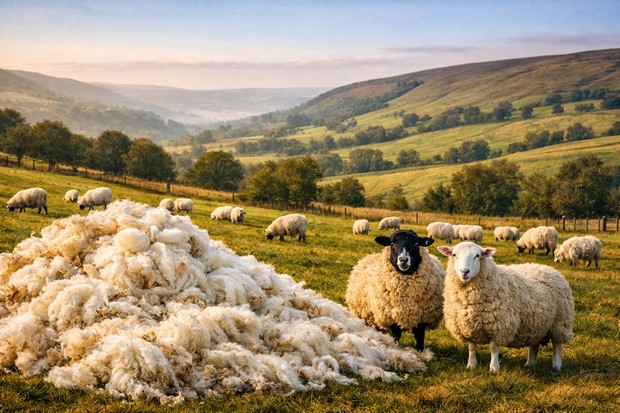
The fleece of primitive domesticated sheep contained a long, hairy outer coat and a light, downy undercoat. In present-day domesticated sheep, the fleece used for apparel and interiors comes mainly from the soft undercoat. The heaviest and coarsest hair fibers are called kemp. Kemp fibers are often short and do not take dye well. The Spanish developed the Merino sheep, whose fleece contains no kemp. A small amount of kemp is still found in many other sheep breeds and is best avoided in anything worn close to the skin.
Sheep raising in the United States began on the Atlantic seaboard in the early 1600s and later spread rapidly westward. Following the U.S. Civil War, sheep production expanded with the opening of free grazing lands west of the Mississippi. By 1884, the peak year, the United States had 50 million sheep.
How Wool Is Produced
Wool is produced in about 100 countries, from small family farms to large commercial operations. The Food and Agriculture Organization of the United Nations estimates annual wool production at around 2.1 million tons. China and Australia are the largest producers, followed by Eastern Europe, New Zealand, Turkey, Argentina, and South Africa. Although wool represents only about 1.3% of world fiber production, it remains important to many economies and rural ways of life.
The most important sheep breeds for fiber production are Merino, Crossbred, and Comeback. Australia produces about 50% of the world’s Merino wool and is best known for fine fibers. New Zealand is an important producer of coarser wool, much of it used in carpets. Merino fleece is the most valuable wool because it is dense, fine, and highly crimped. Good-quality Merino fleeces may weigh 15 to 20 pounds each, and the fibers are usually 3 to 5 inches long. Merino wool is used to produce high-quality, long-wearing products with a soft hand, luster, and good drape.
The United States is a very minor producer of wool, accounting for about 0.7% of world supply. Sheep are raised throughout the country, but most U.S. wool comes from ranches in California, Colorado, Wyoming, Utah, and Texas. The greatest share of U.S. production is medium-grade wool from animals raised for meat. These fibers have a larger diameter than fine wools and vary in length from about 1½ to 6 inches. They are especially useful for carpeting, where their coarser character gives high resiliency and good abrasion resistance. The limited amount of fine wool produced in the United States comes mainly from Delaine-Merino, Rambouillet, Debouillet, and Targhee sheep, with much of it grown in Texas and California. This fine wool is usually about 2½ inches long and is often used in products that compete with higher-priced Merino wool.
Other breeds that produce good-quality wool include Corriedale, Rambouillet, Cormo, Booroola Merino, Debouillet, Border Leicester, and Delaine Merino. Many of these fibers are used in fine apparel and furnishings.
Wool Fiber Structure and Composition
Sheep are generally sheared once a year in spring. The fleece is removed in minutes with power shears that look like large barber’s shears. A good shearer can handle 100 to 225 sheep a day. The fleece is removed in one piece with long, smooth strokes, beginning at the legs and belly. After shearing, it is folded and bagged for shipment to market.
As alternatives to shearing, a chemical feed additive and an injection have been developed. When digested, the feed additive makes the wool brittle so the fleece can later be pulled off the sheep. The injection causes the sheep to shed the fleece a week or so later. Both alternatives are designed to reduce shearing costs.
Newly removed wool is called raw wool or grease wool. It contains between 30% and 70% impurities by weight, including sand, dirt, grease, and dried sweat, or suint. Removing these impurities produces clean, or scoured, wool. The grease is purified to lanolin and is used in creams, cosmetics, soaps, and ointments.
Grading and sorting are two marketing operations that group wools of like character together. Grading evaluates the whole fleece for fineness and length. Sorting separates a single fleece into sections of different quality. The best-quality wool comes from the sides, shoulders, and back; the poorest wool comes from the lower legs. Wool quality helps determine end use. Fine wool is well suited to lightweight worsted fabric, while coarse wool works well in carpets.
The length of Merino wool and other fine wool fibers ranges from about 1½ to 5 inches, depending on the animal and the time between shearings. Long, fine fibers used for worsted yarns and fabrics average about 2½ inches. Worsted refers to a compact yarn and implies longer fibers and greater uniformity after combing. Shorter fibers, averaging about 1½ inches, are used in woolen fabrics. Woolen describes a softer, more loosely twisted yarn with shorter, less uniform, and less parallel fibers. Some sheep breeds produce coarse, long wools 5 to 15 inches long for specialty and handcrafted fabrics.
The diameter of wool fiber varies from 10 to 50 micrometers. Merino lamb’s wool may average about 15 micrometers in diameter. Wool has a complex structure with a cuticle, cortex, and medulla. The medulla, when present, is a microscopic honeycomb-like core with air spaces that increase insulating power. It is usually absent in fine wool. The cortex is the main part of the fiber and consists of long, flattened, tapered cells with a nucleus near the center. In natural-colored wools, the cortical cells contain melanin, the pigment that gives color.
The cortical cells on the two sides of the wool fiber react differently to moisture and temperature. This difference creates wool’s unique 3D crimp, the back-and-forth waviness that may be as high as 30 crimps per inch in fine Merino wool or as low as 1 to 5 crimps per inch in low-quality wool. Crimp gives wool three important properties: cohesiveness, elasticity, and loft. It helps individual fibers cling together in yarn, increases yarn strength, and allows the fiber to act like a spring. When force is removed, the undamaged wool fiber gradually returns to its crimped position. Crimp also contributes to the bulk and softness that make wool ideal for sweaters.
Wool is a natural bicomponent fiber. It has two cell types in the cortex with slightly different properties. Their ratio influences crimp and dye affinity. Wool’s molecular structure is also important. Wool fiber is a cross-linked protein called keratin, the same protein found in horns, hooves, human hair, and fingernails. Keratin contains carbon, hydrogen, oxygen, nitrogen, and sulfur. Its flexible molecular chains are held together by natural cross-links—cystine, or sulfur, linkages and salt bridges—that connect adjacent molecules.
A simple ladder model helps explain wool’s behavior. If a ladder is pulled askew, the crossbars help it recover its shape. Wool behaves in much the same way. A more realistic model includes both ladderlike and helical regions. About 40% of the chains are in a spiral formation, with hydrogen bonding between the closer parts. The spiral acts like a spring and contributes to resiliency, elongation, and elastic recovery. The cystine linkage is the most important part of the molecule. Any chemical, such as alkali, that damages this linkage can destroy the structure.
Wool fabrics can be shaped by heat and moisture, which is one of the fiber’s great advantages. Puckers can be pressed out, excess fabric can be eased and pressed flat or rounded, and pleats can be set with heat, steam, and pressure. Hydrogen bonds break and reform easily during steam pressing. The newly formed bonds hold the pressed shape until the fabric is exposed to high humidity.
Key Properties of Wool
Wool has a matte luster, and its appearance varies with the type of animal, yarn structure, fabric structure, and finish. Wool can appear in sheer voiles, printed challis, flannels, tweeds, heavy coatings, upholstery fabrics, rugs, and carpets. Because of its structure, wool contributes loft and body to fabrics. Wool sweaters, suits, carpets, and upholstery are still standard references for the performance of manufactured fibers.
Durability is high. Wool’s excellent elongation and elastic recovery make it highly resilient. When stress is placed on the fabric, the crimped fibers stretch as the molecular chains uncoil; when stress is removed, the cross-links help the fibers return almost to their original positions. Wool fibers can be bent back on themselves 20,000 times without breaking, compared with about 3,000 times for cotton and 75 times for rayon. Atmospheric moisture helps wool retain flexibility, and wool carpets can become brittle if the air is too dry.
Wool is also comfortable. It is more hygroscopic than any other fiber, with a moisture regain of 13% to 18% under standard conditions. In light rain or snow, wool resists wetting and water tends to bead on the surface. Because wool is a poor conductor of heat, body warmth is not dissipated readily. Its resiliency keeps fabrics porous, allowing them to trap air, which is an excellent insulator. Some people are allergic to lanolin or find coarse wool irritating. Wool has a medium specific gravity of 1.32, so it often feels substantial and warm in cold-weather clothing.
Wool receives a high rating for appearance retention. It resists wrinkling well and maintains its shape during normal use. Wool is especially resilient when dry and performs well in dry cleaning. When wool garments are properly cared for, they retain their size, shape, and attractive appearance for years.
How to Care for Wool
Dry cleaning is recommended for wool unless it is specifically treated to be washable. Wool does not soil readily, and soil removal is relatively simple. Grease and oils do not spot wool as quickly as they do on many other fibers. Wool items also do not need to be washed or dry-cleaned after every use. A soft brush removes dust and returns matted fibers to their original position. Garments should rest between wearings, and a humid environment or a fine mist of water can help recovery from creases and deformations.
Wool is very susceptible to damage when wet. Its wet tenacity is lower than its dry strength, while its resiliency and elastic recovery decrease. If hand washing is allowed, use warm water that is comfortable to the hand, avoid agitation, support the item, and air-dry it flat. Do not machine- or tumble-dry wool unless the label says it is safe. Machine-washable woolens are usually blends or specially finished fabrics and generally require gentle washing and flat drying.
Chlorine bleach damages wool, and strong alkalis such as harsh detergents are also harmful. Wool may turn yellow, become slick and jellylike, and finally dissolve. In blends, the wool may disappear and leave only the other fiber. Wool is also attacked by moth larvae and carpet beetles. Regular use of mothballs or crystals is discouraged because of toxicity, but they may be used when evidence of insects is present. Better storage methods include airtight containers, clean closets, vacuuming, and keeping wool items free of sweat, skin flakes, and food stains. Wool burns very slowly and is self-extinguishing, which is why it is regarded as flame-resistant.
Wool Sustainability and Traceability
Wool is a renewable natural fiber, but it is not produced without environmental impact. Sheep graze closely, so overgrazing can cause soil erosion. Manure is often spread over the ground to return nutrients to the soil, but excessive application can create runoff problems during spring thaw or heavy rain. Sheep producers have also faced concerns related to predator control, shearing practices, and the health and back problems associated with shearing large numbers of animals.
Sheep are susceptible to diseases and parasites. Some diseases are of concern mainly to producers, but customs officials and importers may check imported wool from some countries to prevent disease transmission through contaminated fibers. Parasite control often relies on pesticides applied by injection, pour-on, or dipping methods. If these liquids are disposed of improperly, they can contaminate lakes, streams, and other water systems and harm aquatic life.
Organic wool comes from sheep fed organically grown feed, grazing on land not treated with pesticides, and not dipped in synthetic pesticides. A small percentage of wool is organic, but interest is growing. Some sheep are free-range and graze in open pastures. Merino sheep have wrinkled skin, especially around the tail area, and these wrinkles can collect moisture and urine and attract flies. Ranchers sometimes remove excess skin from this area to prevent flystrike, especially in organic systems where insecticides are prohibited. Animal-rights activists object to this practice and to shearing itself.
Traceability has become more important in the wool industry. Some companies use barcodes so consumers can trace wool from the grower through production and back to the ranch of origin. Other programs accredit growers who meet standards for fiber quality, animal welfare, environmental care, and social and economic values. The local fiber movement is also growing. Small-scale farmers and backyard shepherds often sell raw fiber and finished goods, including natural-colored fleeces in beige, gray, brown, and black. A fibershed is a geographic region that supplies the fiber, dyes, and labor needed for a fully local wardrobe.
Wool processing also has environmental costs. Scouring greasy wool requires hot water or solvent cleaning before it can be made into yarn. The cleaning process produces wool grease sludge with a high pollution index. Lanolin is usually reclaimed, but pesticides may remain in the grease. Many wool products require dry cleaning, and some dry-cleaning solvents have been identified as possible carcinogens.
Uses of Wool in Apparel and Interiors
Only a small amount of wool is used in the United States, but its most important use is adult apparel like sweater garments. Wool suits perform well and look excellent. They fit well because they can be shaped through tailoring, and they drape beautifully. They are comfortable under a variety of conditions and retain their appearance during wear and care. Suit fabrics are also made in wool/synthetic blends. The Woolmark Company operates a global licensing program that endorses 100% wool merchandise and selected wool blends.
Wool also remains the standard by which carpet appearance is judged. It is widely used in carpets and custom rugs, including machine-woven Axminster and Wilton types, hand-woven rugs, and hand-hooked rugs. Wool carpets and rugs are more expensive than those made from other fibers because their rich color, texture, and appearance are highly valued. Wool and wool-blend fabrics are also used in upholstery because of their aesthetic qualities, appearance retention, durability, and natural flame resistance. In residential use, additional flame-retardant treatment may not be necessary, but many commercial and contract applications require it.
Handcrafted wall hangings and woven tapestries are often made of wool because textile artists value the way the fiber handles. Designers, artists, and consumers appreciate the look and wear of finished wool items. Wool is also used in fire-safety blankets, stadium blankets, throws, felts, foundation pads under heavy machinery, and materials that reduce noise and vibration. Tiny balls of wool can absorb up to 40 times their weight in oil and are used to clean up oil spills. Wool mulch mats are used for landscape and horticultural weed control. Fair Trade organizations also support hand-felted wool products that provide income and help preserve traditional crafts.
Specialty Wools
Most specialty wools come from the goat, rabbit, and camel families. They are available in smaller quantities than sheep’s wool and are usually more expensive. Like all natural fibers, specialty wools vary in quality, and most require dry cleaning. Hobbyists and fiber enthusiasts raise Angora goats, Angora rabbits, llamas, alpacas, yaks, and camels, often selling through fiber shops, online retailers, and local fairs and festivals.
Specialty wool fibers are of two kinds: the coarse, long outer hair and the soft, fine undercoat. Coarse fibers are used for interlinings, upholstery, tote bags, and some coatings. Fine fibers are used in luxury coats, sweaters, shawls, suits, dresses, and interior textiles. Handcrafted items often make use of both fiber types.
Conclusion
Wool remains a premium textile fiber because of its warmth, resilience, comfort, and natural beauty. From fine Merino apparel to durable carpets, upholstery, blankets, and specialty handcrafts, wool continues to set the benchmark for performance in both fashion and interiors. Despite competition from synthetic fibers, its unique structure and long-standing usefulness ensure that wool will remain a valuable fiber for generations to come.
References
[1] Kadolph, S. J. (2010). Textiles (11th ed.). Pearson Education.
[2] Tortora, P. G., & Merkel, R. S. (2014). Fairchild’s Dictionary of Textiles (8th ed.). Fairchild Books.
[3] Collier, B. J., & Tortora, P. G. (2001). Understanding Textiles (6th ed.). Prentice Hall.
[4] Cook, J. G. (1984). Handbook of Textile Fibres: Natural Fibres (Vol. 1, 5th ed.). Woodhead Publishing.
[5] Hearle, J. W. S., & Morton, W. E. (2008). Physical Properties of Textile Fibres (4th ed.). Woodhead Publishing.
[6] Goswami, B. C., Anandjiwala, R. D., & Hall, D. M. (2004). Textile Sizing. CRC Press.

Editor of Fashion2Apparel. She is a fashion designer and ex-lecturer in Fashion Designing. She wants to spread fashion knowledge throughout the world.