Hand knitting remains a craft, while machine knitting is carried out on flat or circular machines. The direction in which yarns run distinguishes weft knits from warp knits. Machine needles form the loops, and gauge describes how closely the stitches are set. These fundamentals provide a starting point for understanding knitted fabrics and how they are classified.
What Is Knitted Fabric?
Knitted fabrics are formed by interlocking loops of yarn. The interlocking of these loops can be done by either vertical or horizontal movement.
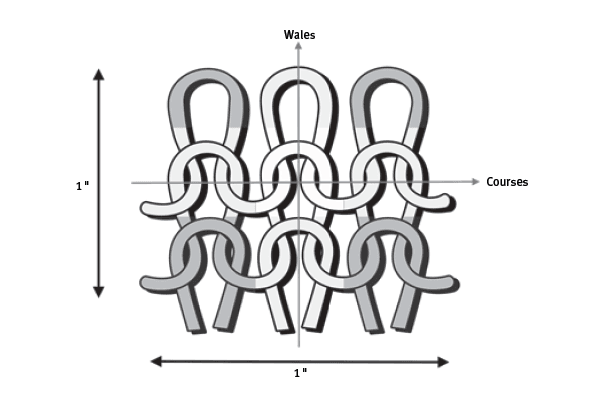
In knitting terminology, the rows of stitches that run in columns along the lengthwise direction of the fabric are known as wales. This corresponds to the warp direction of woven fabrics. Crosswise rows of stitches or loops are called courses. The direction of the courses corresponds to the filling of woven goods. The number of courses and wales in a knitted fabric can be counted with a pick glass and reported for fabric specifications.
Warp Knitting vs. Weft Knitting
When yarns are introduced in a crosswise direction, at right angles to the direction of growth of the fabric, and run or interlock across the fabric, the knit is known as a weft knit. When the yarns run lengthwise or up and down, the knit is known as a warp knit.
In warp knits, one or more yarns are allotted to each needle on the machine, and those yarns follow the long direction of the fabric. For weft knits, one or more yarns are used for each course, and these yarns move across the fabric. In weft knits, one yarn may have from twenty to several hundred needles associated with it. To summarize, weft knits can be made with one yarn, but warp knits must have a whole set of warp yarns, that is, one or more for each needle.
Weft knits may be hand- or machine-made, and hand knitting is still a craft of interest. Warp knits can be produced only by machine.
Types of Knitting Machines
Knitting machines may be either flat or circular. The flat-type knitting machine has needles arranged in one or two straight lines and held on a flat needlebed. The cloth is made by forming stitches on these needles. The resulting fabric is flat. Machines with flatbeds are used to make both warp and weft knits.
The circular knitting machine has needles arranged in a circle on a rotating cylinder. The resulting fabric is formed into a tube. Circular knitting machines produce weft knits almost exclusively.
How Knitting Loops Are Formed
Loops are formed in machine knitting by hooked “needles.” The latch needle, with a crook top and a latch that opens and closes, is the most commonly used.
Latch Needle Loop Formation
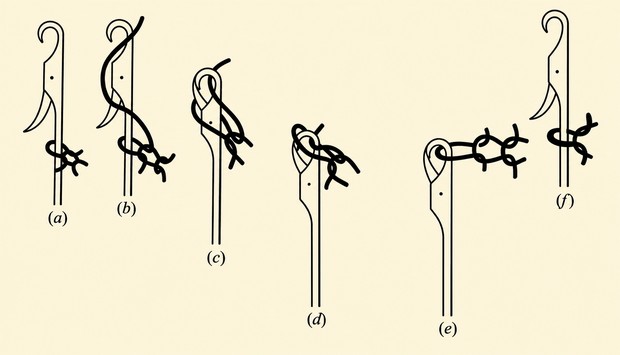
The steps in formation of loops with the latch needle are described below:
- The old loop is held on the stem of the needle. The latch is open (a).
- The hook grasps the yarn to begin forming a new loop (b).
- The needle falls; the old loop rises, closing the latch of the needle (c).
- The old loop is cast off (d) and (e).
- The needle rises, and the new loop slides down to the stem of the needle, pushing the latch open again. The needle is ready to repeat the cycle (f).

Figure: Formation of a loop by a latch needle
Compound Needles for Warp Knitting
Another type of needle, the compound needle, is used almost exclusively for warp knitting. The compound needle has two components: a hook and a tongue. During loop formation, the hook and tongue move up and down, but at different speeds, with the tongue performing essentially the same function as the latch in the latch needle.
Knitting Machine Parts: Needle Beds, Feeders, and Sinkers
The needles in knitting machines are held in a needlebed, or needle bar. Cam systems provide the action for lifting the needles as the yarn is fed in. The needle’s engagement with a new piece of yarn is called feeding. Devices called feeders are located to introduce the yarn to the needles.
The number of feeders can vary. The more feeders a machine has, the higher the speed of fabric formation on the machine will be, because each needle produces a loop each time it is activated. When many needles are activated more frequently, many courses can be formed at the same time.
Another important element of some knitting machines is the sinker. The already formed fabric may need to be controlled as the subsequent knitting action takes place. A thin steel device called the sinker may be used to hold the fabric as the needle rises, support the fabric as the needle descends, and push the fabric away from the needle after the new loop has been formed. Sinkers are generally mounted between the needles. Some machines, however, do not use sinkers but instead use the tension in the completed fabric for control.
Knitting Gauge and Fabric Quality
The size of the needle and the spacing of the needles on knitting machines determine the number and size of the knit stitches and their closeness. Each wale is formed on one needle. The number of needles is equal to the number of wales. The closeness of the stitches determines whether a knit fabric will be lightweight and open or heavier and denser.
The term gauge is used to describe the closeness of knit stitches. Gauge is the number of needles in a measured space on the knitting machine. Higher-gauge fabrics, those with more stitches, are made with finer needles; lower-gauge fabrics are made with coarser or larger needles.
The term cut is also used to designate the number of needles per inch in the needlebed of a circular weft-knitting machine. To describe the stitch density of a single- or double-knit fabric, the fabric may be designated as an eighteen-, twenty-, twenty-two-, or twenty-four-cut fabric. The higher the cut, the closer the stitches; the lower the cut, the coarser the fabric.
Varying types of knitting machines measure gauge over different distances on the machine. For example, circular-knit hosiery measures the number of needles in 1.0 inch, full-fashioned knitting in 1.5 inches, and Raschel knits in 2.0 inches. Because of these differences, it is best to keep in mind the general principle that the higher the gauge, the closer the stitches.
The quality of needles used in manufacturing knit goods is related directly to the quality of the fabric produced. Needles of uneven size and quality will produce knit fabrics with uneven-sized stitches and imperfect surface appearance.
How Knitted Fabrics Are Classified
Once the basic distinction between warp and weft knits has been made, further subdivisions of knit classifications are usually based on the types of machines used in their production. The majority of knit fabrics are named after the machines on which they are constructed.
Conclusion
Weft and warp knits differ in yarn direction and in how yarns are assigned to needles or courses. Loop formation depends on latch or compound needles, while feeders and sinkers help introduce yarn and control the fabric during knitting. Gauge describes needle spacing and stitch closeness, and needle quality affects stitch regularity and surface appearance. These basics set the stage for examining the specific knit fabrics made on different machines.
Editor of Fashion2Apparel. She is a fashion designer and ex-lecturer in Fashion Designing. She wants to spread fashion knowledge throughout the world.